Structural Drying and Dehumidification in Spokane, WA
Pulling the standing water is only half the job. Local crews dry the structure itself to a measured target, so a wet Spokane wall does not become a moldy one weeks later.
How Structural Drying is handled in Spokane
Call & dispatch
The response team answers 24/7, and the nearest crew heads out with pumps, air movers, and moisture meters.
Assess & stop it
The crew finds the source and moisture-maps how far the water traveled, into subfloors, wall cavities, and below grade.
Extract & dry
The extraction crew pulls the standing water, then runs air movers and low-grain dehumidifiers to a verified dry standard.
Verify & document
Crews log the readings until the structure is dry, then document the loss with photos and daily moisture logs for the claim file.
After the water is out, the structure is still full of moisture you cannot see. Drywall, framing, subfloor, and insulation all hold water long after the floor looks dry. Structural drying is the part that takes a wet Spokane home back to a real dry standard, and it is what keeps a one time flood from turning into a mold problem in the weeks that follow.
Why drying to a target matters
A floor that feels dry is not the same as a wall that is dry. Moisture wicks up into baseboards and behind cabinets and sits inside cavities where nothing evaporates on its own.
If that water is left in the structure, it feeds the growth that the EPA moisture control guidance warns about, usually within a couple of days. Drying to a measured target is the difference between a repair that holds and one that fails behind fresh paint.
- Secondary damage like swollen trim, delaminating flooring, and buckled subfloor
- Hidden growth inside wall cavities and under saturated insulation
- Musty odor that keeps coming back after the surface is dry
- Cupped hardwood that could have been saved if dried in time
How local crews dry a Spokane structure
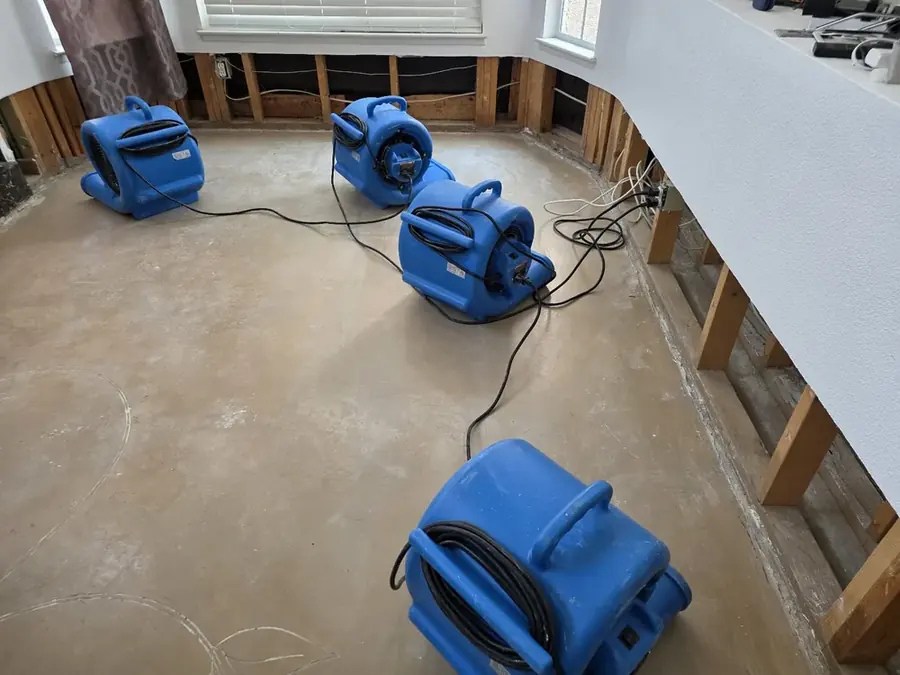
Drying is a controlled process, not just fans on a floor. Local crews read the moisture first, set the right equipment for the space, and let the numbers tell us when it is done.
- Meter the affected materials and set a dry standard from an unaffected area of the same home
- Place air movers to push evaporation off wet surfaces
- Run low grain refrigerant (LGR) dehumidifiers to pull that moisture out of the air
- Take daily readings and adjust the equipment as the structure gives up its water
This phase always follows water extraction, so the standing water is gone before the dryers go in. On older South Hill and Browne's Addition homes with plaster and layered flooring, the drying can take a few extra days, and the meter is what tells us the truth.
Documenting the dry-out for your carrier
The daily log is not busywork. It is the record that shows your insurer the structure actually reached a dry standard, which protects you if a question comes up later.
- Daily moisture readings logged for each affected room
- Photos of equipment placement and progress
- A clear scope your adjuster can follow
- Handoff to crawl space or basement drying where the water reached those areas too
The CDC cleanup guidance is clear that porous items soaked with dirty water may need to go, and its cleanup safety pages back that up. Photos and daily moisture logs documented for the claim file.
Wet framing does not dry on its own. Get the right equipment running today.
☎ Call (509) 236-9148Why Spokane calls the local pros first
Rapid local response
The response team answers 24/7, and the nearest crew heads out the moment you call, across Spokane and Spokane County.
IICRC S500 drying standard
Trained crews with truck-mounted extractors, air movers, and moisture meters dry to a verified standard, not a mop and a fan.
Claim-ready documentation
The loss is documented with photos and daily moisture readings, the paperwork an adjuster needs to move a claim.
Local water experts
Frozen and burst pipes, ice dams, snowmelt, and flooded basements, so the local pros know how water moves in an Inland Northwest home.
Spokane and Spokane County covered.
Rapid local response across the region, 24/7. Here is where the local crews work, down to the ZIP.
Local crews cover all of Spokane and Spokane County, day or night, with rapid local response.
Coverage runs across South Hill, Downtown, the North Side, Hillyard, Spokane Valley, Liberty Lake, Cheney, and Airway Heights.
See every neighborhood and ZIP covered ›